A fine mechanical watch is designed to outlive its owner, but it cannot do so without proper care. Operating continuously on your wrist, a watch movement is subjected to friction, temperature fluctuations, and environmental hazards. Establishing a disciplined maintenance routine is the responsibility of every serious collector.
The Servicing Interval
Inside a mechanical movement, tiny synthetic rubies act as bearings for the gear train. Specialized synthetic oils are applied to these friction points. Over time, these oils degrade, dry out, or migrate. When this happens, metal grinds against synthetic ruby, creating dust and causing permanent wear.
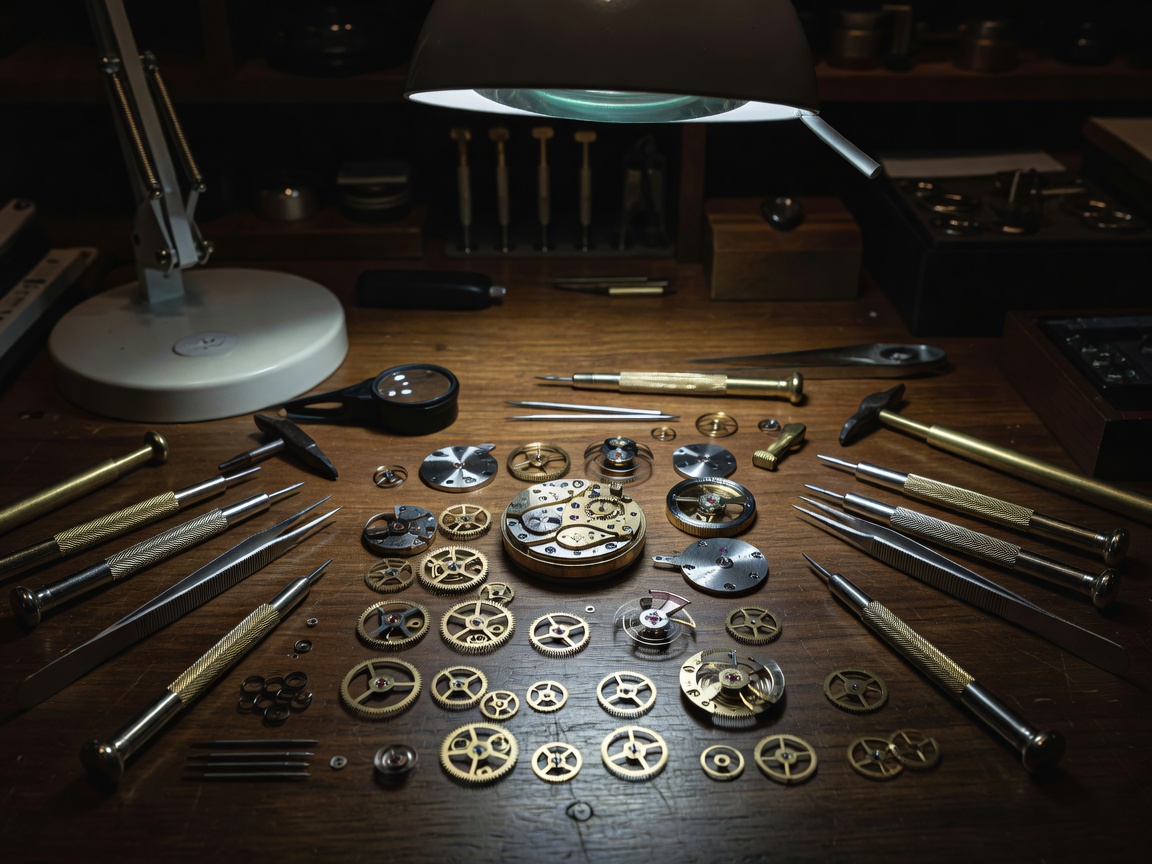
Generally, a modern mechanical watch requires a full overhaul every 5 to 7 years. Vintage pieces may require attention more frequently, depending on the condition of the parts and the type of lubricants originally used. A full service involves completely disassembling the movement, cleaning every part in ultrasonic baths, reassembling, re-lubricating, and regulating the timing.
Water Resistance and Gaskets
Water resistance is not a permanent state. The rubber gaskets (O-rings) that seal the caseback, crystal, and crown degrade over time due to exposure to sweat, chlorinated water, cosmetics, and simple aging.
- Annual Testing: If you swim or dive with your watch, it should be pressure-tested annually. This is a quick, inexpensive test that can prevent catastrophic water ingress.
- The Crown: Always ensure a screw-down crown is fully secured before exposing the watch to water. Never operate chronograph pushers underwater unless explicitly designed for such use.
- Rinsing: After exposure to saltwater or chlorine, always rinse the watch under fresh tap water to prevent corrosion and salt crystal buildup.
The Invisible Enemy: Magnetism
In our modern environment, strong magnetic fields are everywhere: laptops, tablet covers with magnetic closures, speakers, and MRI machines. If a watch is exposed to a strong magnetic field, the coils of the delicate hairspring can stick together. This drastically shortens the effective length of the spring, causing the watch to suddenly run very fast (often gaining several minutes a day).
Fortunately, magnetism is easily cured. A watchmaker (or a hobbyist with an inexpensive demagnetizer) can pass the watch through an alternating magnetic field to remove the charge in seconds, restoring perfect timekeeping without opening the case.
Daily Habits
Finally, how you interact with your watch matters. When manually winding, wind the watch off the wrist to avoid putting lateral stress on the winding stem. Avoid setting the date between 9:00 PM and 3:00 AM, as the date-change gears are engaged during this window, and manual forcing can break delicate teeth.
A disciplined approach to maintenance transforms watch ownership from a passing interest into a lifelong stewardship of mechanical art.